

What is Business Technology, and Why You Need to Know More
Every small business owner I've talked to in the last five years has had the same moment of realisation.
They are staring at a competitor who seemingly came out of nowhere, moving faster, serving customers better, and somehow operating with half the overhead.
The difference almost always comes down to technology: not just having it, but understanding how to wield it strategically.
Business technology isn't the computers in your office or the software your team complains about.
It's the entire ecosystem of tools, systems, and digital infrastructure that determines whether your company thrives or slowly becomes irrelevant.
And here's what frustrates me about most explanations of this topic: they treat it like a shopping list instead of what it actually is, which is the nervous system of modern commerce.
If you're running a company, managing a department, or even just trying to understand where your industry is headed, you need to know more about business technology than the basics.
You need to understand how these systems interconnect, why certain investments pay off while others drain resources, and which emerging trends will separate market leaders from everyone else.
The companies that figured this out early are now the ones setting the pace. The rest are playing catch-up with shrinking margins.
Defining Business Technology For Small Business Owners In Melbourne
The term gets thrown around boardrooms and pitch decks constantly, but most definitions miss what actually matters.
Business technology encompasses every digital tool, system, and infrastructure component that enables a company to operate, compete, and grow.
That includes everything from the servers humming in data centers to the apps your sales team uses on their phones.
What separates business technology from consumer technology is intent.
Your personal laptop and your company's enterprise resource planning system might share similar components, but they serve fundamentally different purposes.
Business technology exists to solve operational problems, create competitive advantages, and generate measurable returns.
The Evolution from Back-Office Tools to Strategic Assets For Business Owners
Twenty years ago, technology lived in the IT department's basement.
It processed payroll, stored files, and occasionally crashed at the worst possible moment.
Leadership viewed tech spending as a necessary evil: something to minimize rather than maximize.
That perspective died sometime around 2010, and companies that still hold it are struggling.
Technology migrated from supporting business operations to driving them entirely. Consider these shifts:
- Retail moved from physical inventory management to algorithmic demand prediction
- Marketing transformed from gut-feel campaigns to data-driven personalization
- Customer service evolved from call centers to AI-assisted omnichannel support
- Manufacturing adopted sensors and predictive maintenance over scheduled repairs
The companies that recognised this shift early gained advantages that compound over time.
Amazon didn't become dominant because they had better warehouses.
They became dominant because they treated logistics technology as a core competency worth billions in investment
Hardware, Software, and Networking For Small Business Owners
Strip away the complexity, and business technology rests on three pillars.
Hardware includes every physical device: servers, workstations, mobile devices, IoT sensors, and networking equipment.
Software covers operating systems, applications, databases, and the custom code that makes your specific operations possible.
Networking ties everything together, enabling communication between devices, systems, and people.
Most businesses underinvest in networking and overinvest in flashy software.
I have watched companies spend six figures on CRM implementations that crawl because they're running on network infrastructure from 2015.
The unsexy components often determine whether the exciting ones actually work.
The Essential Role of Tech in Competitive Advantage For Business Owners
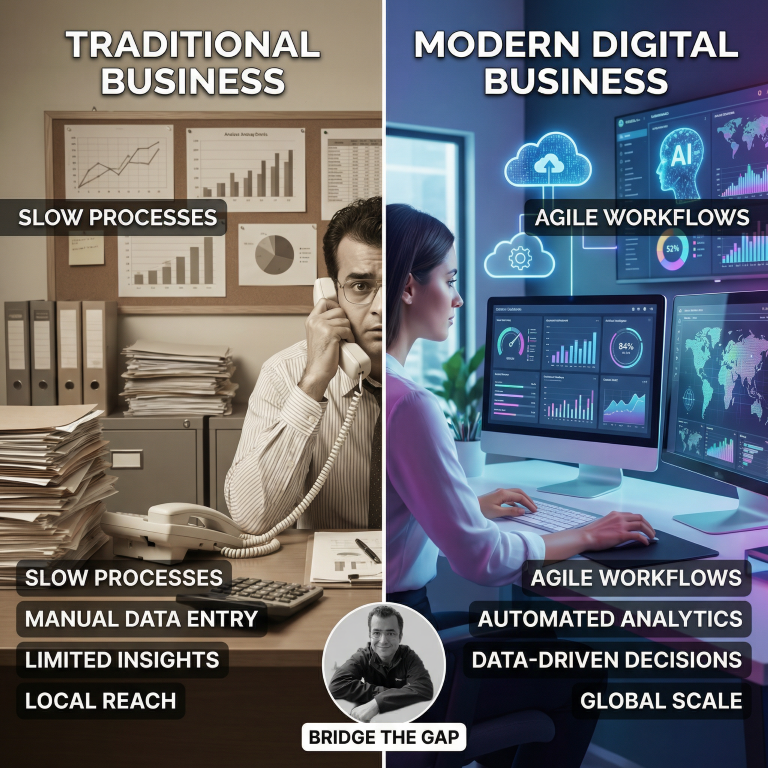
Technology stopped being optional around the time smartphones became ubiquitous.
Now it determines who wins and who disappears.
The advantages fall into three categories that build on each other.
Streamlining Operations through Automation For Business Owners
Manual processes are expensive, error-prone, and impossible to scale.
Every hour an employee spends on tasks a computer could handle is an hour not spent on work that actually requires human judgment.
Effective automation targets high-volume, rule-based activities.
Invoice processing, appointment scheduling, inventory reordering, and report generation are prime candidates.
A mid-sized logistics company I worked with reduced their billing department from twelve people to four by automating 80% of their invoice workflow.
Those eight employees didn't get fired: they moved into customer relationship roles where human interaction actually mattered.
The key is identifying which processes deserve automation:
Enhancing Customer Experience and Personalisation At The Heart Of Small Business
Customers now expect companies to know them.
Not in a creepy way, but in a way that respects their time and preferences.
Technology makes this possible at scale.
Personalisation engines analyze purchase history, browsing behavior, and demographic data to deliver relevant recommendations.
Chatbots handle routine inquiries instantly while routing complex issues to human agents.
Mobile apps remember preferences and streamline repeat purchases.
The revenue impact is substantial. Personalised email campaigns generate 6x higher transaction rates than generic blasts. Product recommendations drive 35% of Amazon's revenue.
Companies that treat every customer identically are leaving money on the table while simultaneously frustrating the people they're trying to serve.
Data-Driven Decision Making and Analytics For Small Business
Gut instinct built plenty of successful companies, but it doesn't scale reliably.
Data-driven organisations make better decisions more consistently because they're working with evidence rather than assumptions.
Modern analytics platforms can process millions of data points to identify patterns invisible to human analysis.
They can predict which customers are likely to churn, which products will sell next quarter, and which operational bottlenecks are costing the most money.
The challenge isn't collecting data: most companies are drowning in it.
The challenge is turning data into actionable insights and then actually acting on those insights.
That requires both technical infrastructure and organisational culture that values evidence over hierarchy.
Key Categories of Business Technology to Master For Every Small Business Owner In Melbourne
Understanding the major categories helps you evaluate where your organisation stands and where investment might yield the highest returns.
Communication and Collaboration Platforms For Small Business
Remote and hybrid work made collaboration tools essential rather than convenient.
Platforms like Slack, Microsoft Teams, and Zoom became the virtual offices where work actually happens.
Effective collaboration technology does more than enable video calls.
It creates persistent channels for team communication, integrates with other business systems, and provides searchable records of decisions and discussions.
The best implementations reduce email volume by 40-60% while improving response times and information accessibility.
Selection criteria that actually matter:
- Integration capabilities with existing tools.
- Mobility functionality for field teams.
- Security and Compliance features.
- Scalability as teams grow.
- Actual adoption rates, not just feature lists.
Customer Relationship Management (CRM) Systems In Small Business
A CRM system serves as the single source of truth for customer interactions.
Every email, phone call, purchase, and support ticket lives in one place, accessible to anyone who needs it.
The difference between companies that succeed with CRM and those that waste their investment usually comes down to adoption.
A $200,000 Salesforce implementation is worthless if salespeople keep tracking leads in personal spreadsheets.
The technology only works when it becomes embedded in daily workflows.
Successful CRM adoption requires executive sponsorship, thorough training, and integration with tools employees already use.
It also requires accepting that the first six months will be painful as old habits die and new processes take hold.
Cloud Computing and Infrastructure For Small Business Owners
The shift from on-premise servers to cloud infrastructure changed how companies think about technology investment.
Instead of massive upfront capital expenditures, businesses now pay for computing resources as they use them.
Cloud platforms like AWS, Azure, and Google Cloud offer virtually unlimited scalability.
A startup can access the same infrastructure that powers Fortune 500 companies, paying only for what they consume.
Seasonal businesses can scale up during peak periods and scale down when demand drops.
The financial model shift matters as much as the technical capabilities. Converting fixed costs to variable costs improves cash flow and reduces risk.
Companies no longer need to guess their infrastructure needs three years in advance and hope they guessed correctly.
Navigating Challenges and Security Risks Within Small Business

Technology creates vulnerabilities alongside opportunities.
Companies that ignore the risks eventually pay for that oversight, often catastrophically.
Cybersecurity and Protecting Intellectual Property
Every connected system is a potential entry point for attackers.
The average cost of a data breach now exceeds $4 million, and that figure doesn't capture the reputational damage that follows.
Small and mid-sized businesses often assume they're too insignificant to target.
This assumption is dangerously wrong.
Attackers specifically target smaller companies because they typically have weaker defenses and serve as entry points into larger supply chains.
Essential security measures include:
- Multi-factor authentication on all systems.
- Regular security awareness training for employees.
- Endpoint protection and network monitoring.
- Encrypted backups stored offline.
- Incident response plans tested through simultation.
The human element causes most breaches.
Phishing attacks succeed because employees click links they shouldn't.
Strong technical controls matter, but training and awareness matter more.
Managing Technical Debt and Legacy Systems
Every shortcut taken during development, every temporary fix that became permanent, every system that should have been replaced years ago: this is technical debt, and it accumulates interest.
Legacy systems create several problems.
They're expensive to maintain because fewer people understand older technologies.
They can't integrate with modern tools without custom development.
They create security vulnerabilities that can't be patched.
And they slow down every new initiative that needs to interact with them.
Addressing technical debt requires honest assessment of what you're actually running.
Many companies don't have complete inventories of their systems, let alone understanding of the interdependencies between them.
Start with documentation, prioritise based on business impact, and budget for modernization as an ongoing expense rather than a one-time project.
Future-Proofing Your Small Business with Emerging Trends
Predicting specific technologies is a fool's errand, but understanding directional trends helps organizations prepare for what's coming.
The Impact of Artificial Intelligence and Machine Learning
AI has moved from research labs to production systems.
Machine learning models now handle tasks that seemed impossible five years ago: generating marketing copy, analyzing medical images, predicting equipment failures, and optimising supply chains in real-time.
The practical applications matter more than the hype.
AI excels at pattern recognition in large datasets, natural language processing, and optimisation problems with many variables.
It struggles with tasks requiring common sense, novel situations, and ethical judgment.
Companies should identify specific problems where AI capabilities match business needs rather than adopting AI for its own sake.
A machine learning model that improves demand forecasting by 15% delivers concrete value.
An AI chatbot that frustrates customers creates negative value regardless of how sophisticated the underlying technology.
The Shift Toward Remote and Hybrid Work Models
The pandemic accelerated a trend that was already underway.
Companies discovered that many roles don't require physical presence, and employees discovered they prefer flexibility.
Supporting distributed teams requires more than video conferencing.
It requires rethinking how work gets done, how performance gets measured, and how culture gets maintained without shared physical space.
Technology enables remote work, but it doesn't automatically make remote work effective. Successful hybrid organizations invest in:
- Asynchronous communication tools and norms
- Virtual collaboration spaces for creative work
- Security for distributed endpoints
- Manager training for leading remote teams
- Intentional culture-building activities
The companies that figure out hybrid work will access talent pools unconstrained by geography.
Those that insist on full-time office presence will compete for a shrinking pool of candidates willing to commute.
Moving Forward with Intention
Understanding business technology isn't about becoming a technical expert.
It's about recognizing that technology decisions are business decisions with long-term consequences.
The systems you choose, the investments you make, and the capabilities you build today determine your competitive position for years to come.
Start by honestly assessing where your organization stands.
Map your current technology landscape, identify the gaps between where you are and where you need to be, and prioritize investments based on business impact rather than technical novelty.
Talk to your teams about what's working and what's creating friction.
The companies that thrive in the next decade won't necessarily be the ones with the biggest technology budgets.
They'll be the ones that understand how technology creates value and make intentional choices about where to invest.
That understanding starts with asking better questions and refusing to accept "that's how we've always done it" as an answer.